SpaceX wants to launch next Starship this month (and catch it, too), Elon Musk says in 1st earnings call since historic IPO

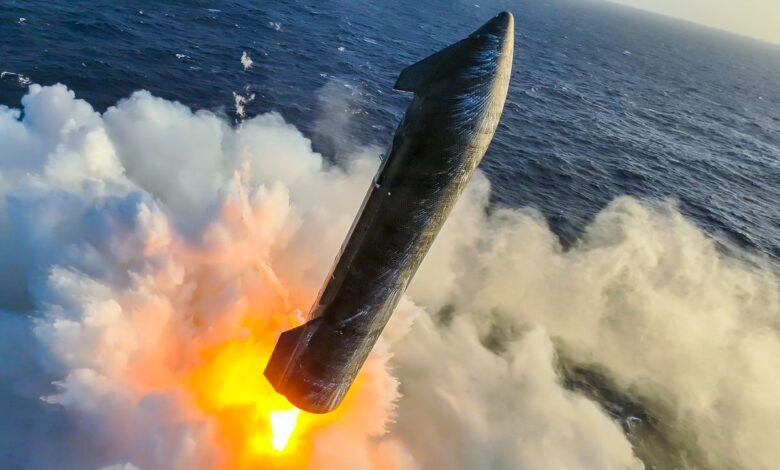
SpaceX will make some history this month, if all goes according to plan.
The company aims to launch the 14th test flight of its Starship megarocket before August is out, Elon Musk said today (Aug. 4) during SpaceX‘s first-ever quarterly earnings call. Starship will deploy viable payloads into orbit on Flight 14, something it has never done before — and there will be other unprecedented action as well.
“I’d say things look very good, and that’s why we, assuming we receive regulatory approval to do so, will attempt to catch the Ship with the tower on the next flight, which is tentatively scheduled for the end of this month,” Musk said during today’s call.
“Ship” is the 171-foot-tall (52 meters) upper stage of Starship, which also features a giant first-stage booster called Super Heavy. Both of these elements are designed to be fully and rapidly reusable — a breakthrough that, combined with Starship’s immense power, will revolutionize spaceflight, according to SpaceX.
And “things look very good” is a reference to Starship Flight 13, which lifted off on July 24. Musk was talking specifically about Ship’s performance on that suborbital jaunt, which ended with the upper stage’s soft splashdown in the Indian Ocean, off the coast of Western Australia.
Ship’s heat shield survived the harrowing downward trip through Earth’s atmosphere in great shape on Flight 13, according to SpaceX (as did the entire vehicle, which is still in one piece to this day). And that gives SpaceX confidence to plan for a tower catch on Flight 14 — a crucial component of Starship’s future reusability.
“I don’t want to jinx it or anything, but I think I’d consider the heat shield problem solved at this point,” Musk said.
Starship’s two launch towers at its Starbase site in South Texas feature large “chopstick” arms, which stack Super Heavy and Ship atop the pad — and can also catch the vehicles when they come back to Earth at the end of their missions.
SpaceX has already executed a tower catch with Super Heavy on three Starship test flights, but it has not yet tried to do so with Ship. So Flight 14 could be momentous, provided SpaceX gets permission from regulators to make an attempt.
Flight 14 will also carry up a batch of SpaceX’s V3 Starlink satellites, a larger and more capable version of the spacecraft that currently populate the company’s broadband megaconstellation. Flight 13 toted 20 Starlink V3s, but Ship deployed them into suborbital space; the satellites will be placed into an operational orbit on the upcoming mission, if all goes to plan, Musk said.
SpaceX goes public
Musk founded SpaceX as a private company back in March 2002. It stayed that way until this past June 12, when SpaceX went public via the richest IPO in history, which raised $86 billion and valued the company at $1.77 trillion.
SpaceX now has to provide earnings reports every quarter, starting with Q2 of this year. And these first publicized numbers show considerable improvement compared to a year ago, according to the company.
The newly released report states that total revenue in the March-June time period was up 92% over the same stretch in 2025 — $7.8 billion versus $4.1 billion. And SpaceX had a net loss during this span of $541 million, down from a net loss of $1.0 billion in Q2 2025.
More than half of this quarter’s revenue — about $4.3 billion — came via the company’s Starlink satellite-internet megaconstellation. That number crystallizes a truth that has been apparent for a while now — SpaceX is not just a launch company anymore.
Rockets will bring in a smaller and smaller share of SpaceX revenue over the coming years, if all goes according to plan. Launch will continue ceding this financial ground to Starlink, but also, increasingly, to SpaceX’s artificial intelligence (AI) operations.
Indeed, SpaceX sees itself becoming more and more of an AI outfit over time. A few months ago, the company revealed that, over the long haul, it’s targeting a “total addressable market” of $28.5 trillion per year, nearly $23 trillion of which will be in the field of “enterprise AI applications.” That’s quite an ambitious goal; in 2025, the gross domestic product of the entire United States was a little less than $31 trillion.
Speaking of ambitious: SpaceX plans to make a lot of this money via an orbiting constellation of one million AI data centers, which together will comprise a constellation known as Starmind. (Yes, SpaceX has a thing for “Star” names.)
SpaceX expects to start launching operational Starmind spacecraft in 2027, Musk said during today’s call. It will take a lot of Starship launches to get the network up and running, but he doesn’t see that as a bottleneck.
“We expect the cadence of flights to be increasing rapidly, and, probably a year from now, we will be doing at least one flight a day, possibly more,” Musk said.