X-ray spacecraft detects the 36-million-degree ‘breath’ of an ancient black hole

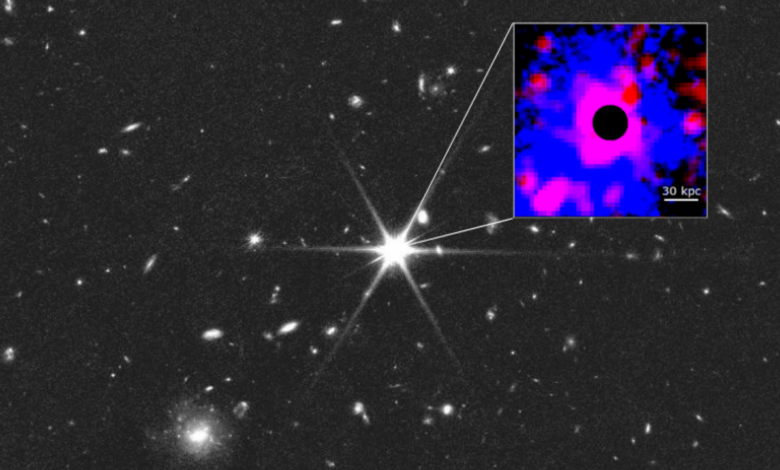
Using NASA’s Chandra X-ray space telescope, astronomers have spotted the blisteringly hot exhaust fumes of one the earliest quasars, cosmic “breath” with temperatures as great as 36 million degrees Fahrenheit. This intensely bright titan is powered by a feeding supermassive black hole engine.
The Chandra X-ray telescope observed a relatively silent quasar that existed 2.1 billion years after the Big Bang. The cosmic “exhaust fumes” from this black hole engines extend out for around 100,000 light-years around a quasar at the heart of a still-forming galactic cluster, or “proto-cluster” called MQN01. These blisteringly hot gas structures will eventually become the atmospheres that envelope modern clusters of galaxies, known as the intracluster medium(ICM).
Thus, this research reveals for the first time the exact moment in cosmic history that these galactic atmospheres began to form and gather.
“The central scientific question is to understand how this hot phase forms: what are the physical conditions of the gas during its formation and what processes contribute to its heating,” team member Sebastiano Cantalupo of the University of Milan-Bicocca said in a statement.
“[The data] show extraordinary properties of the gas that could provide us with the first insights into how this hot phase of the circumgalactic medium, which we now see as intracluster medium, formed.”
Start your engines…
The team behind this research spotted this hot gas structure after 180 hours of X-ray observations conducted by Chandra. Until now, X-ray detections such as this have only been made for quasars that sit in active galactic nuclei (AGNs) at the heart of “radio-loud” galaxies.
The X-ray emissions from these radio galaxies come from jets of particles blasted out from around feeding supermassive black holes at near-light speeds.
But the quasar at the heart of MQN01 differs from these because it is radio-quiet. This means the X-rays detected by Chandra from this quasar are uncontaminated by plasma jets, so the observation is entirely the result of the cosmic “motorbreath” from the quasar.
“We are facing one of the most distant detections of extended thermal X-ray emission associated with the formation of hot gas in dense regions of the universe, which will likely evolve into the known local ICM,” Cantalupo said.
“We believe we have identified a phase in its life in which cold gas falls towards the gravitational potential of this massive halo and is heated by gravitational shocks, reaching temperatures of about 20 million Kelvin [36 million degrees Fahrenheit (20 million degrees Celsius)].
“The densities and pressures we measured are high: one to two orders of magnitude higher than those of clusters in our local universe.”
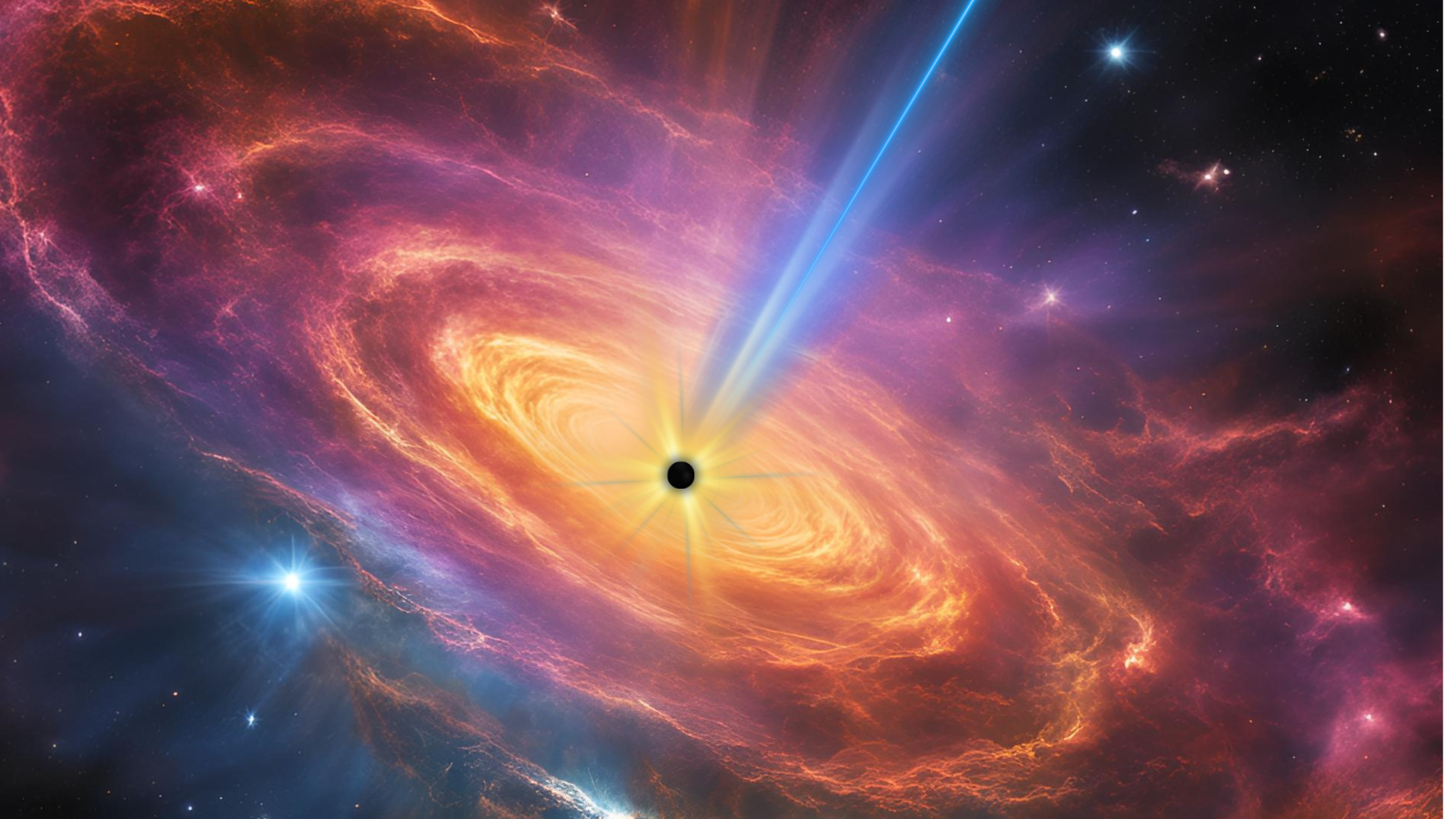
The observations of this radio-quiet galaxy were possible thanks to the application of a technique usually used to analyze Seyfert galaxies, which host feeding supermassive black holes in the local universe (the area of space found within 1 billion light-years of Earth). The challenge the team faced was isolating the faint light from the gas from the blinding glare of gas closer to the central black hole.
“We were initially extremely skeptical ourselves,” team leader Andrea Travascio of the INAF said. “Given the exceptional nature of the data, we sifted through every alternative explanation: from artificial outflows to instrumental contamination or other unsuspected effects. But each alternative scenario encountered insurmountable theoretical limitations. The thermal explanation is the only one consistent with the physical data.”
Travascio and the team are now analyzing archival datasets from hundreds of other quasars to discover if this heating phase is common to protoclusters or if MQN01 is a rarity.
“Considering how unique the result was and also taking into account Chandra’s technical difficulties in the final phases of its mission, the satellite has once again demonstrated its extraordinary ability to produce scientifically relevant results even after decades of operation,” Travascio said.
The team’s research was published on Friday (July 24) in the journal Astronomy & Astrophysics.