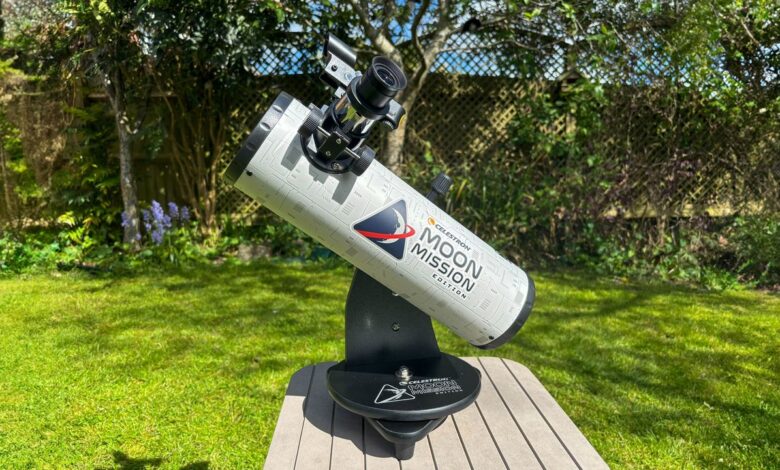
The excitement of the new moon mission has potentially helped create a new generation of stargazers, just like the Apollo program did 60 years ago. These new observers will be looking for a beginner’s telescope that is easy to use and which can show them the craters on the moon in particular. The Celestron Moon Mission 100mm Tabletop Dobsonian could be the perfect entry point for them. It has a superb price-point for its aperture, and is capable of bringing not only the moon, but double stars, the brighter galaxies and nebulas and the moons of Jupiter to your backyard.
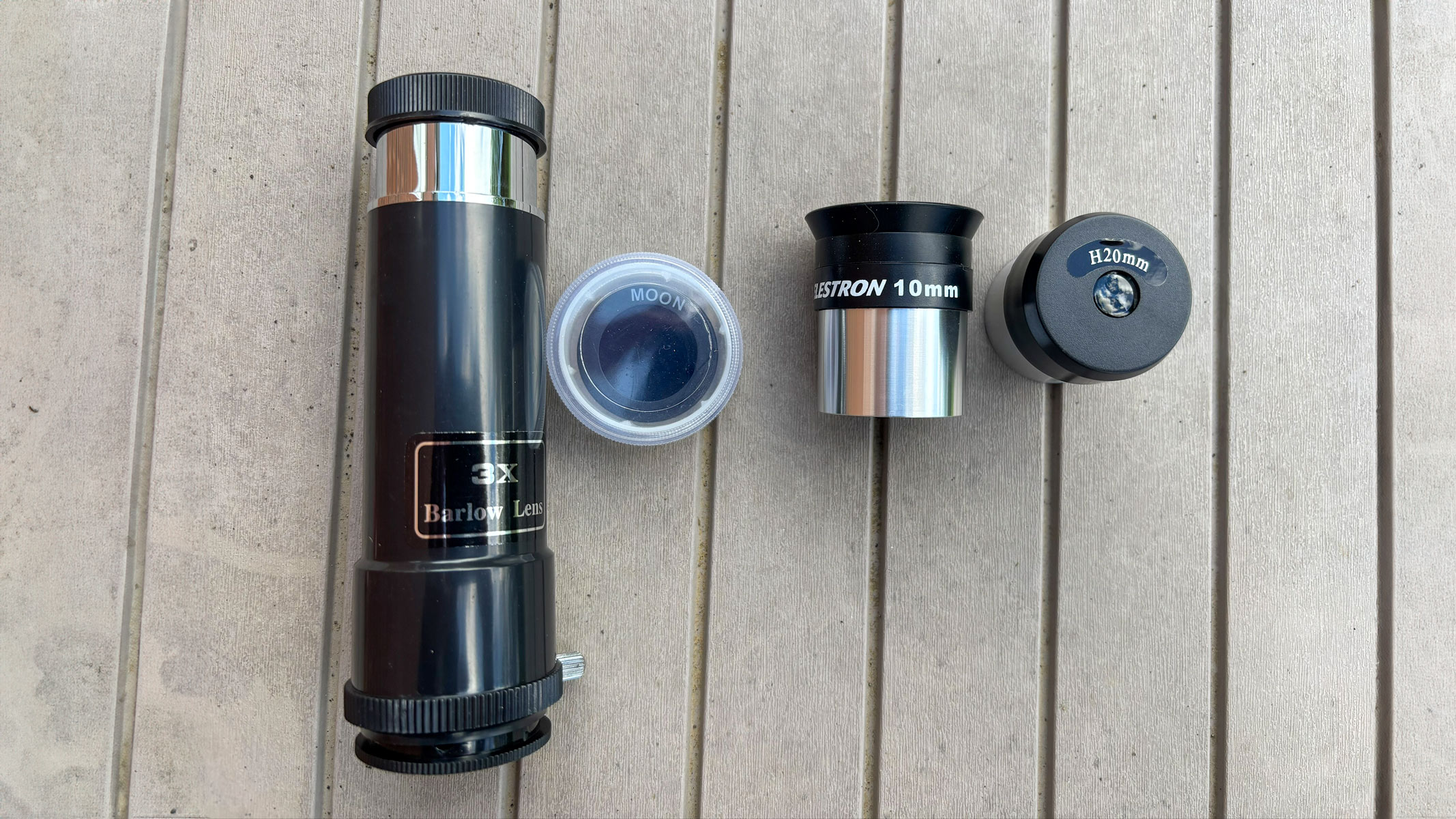
The Celestron Moon Mission 100mm Tabletop Dobsonian comes equipped with 8mm and 20mm eyepieces, one of which is intended specifically for the moon, as well as a red-dot finderscope, a moon filter, a moon-map poster and free access to download the Starry Night planetarium software and Celestron’s SkyPortal app, which is powered by SkySafari.
All in all, it will make an excellent package for someone to get started enjoying the night sky. Though the optics and accessories are not perfect, for the price their drawbacks can be overlooked, and as an entry-level telescope it paves the way for the user to graduate to increasingly more sophisticated telescopes at a later date.
Celestron Moon Mission 100mm Tabletop Dobsonian review
Celestron Moon Mission 100mm Tabletop Dobsonian: Design
- Quick and simple set-up
- Portable
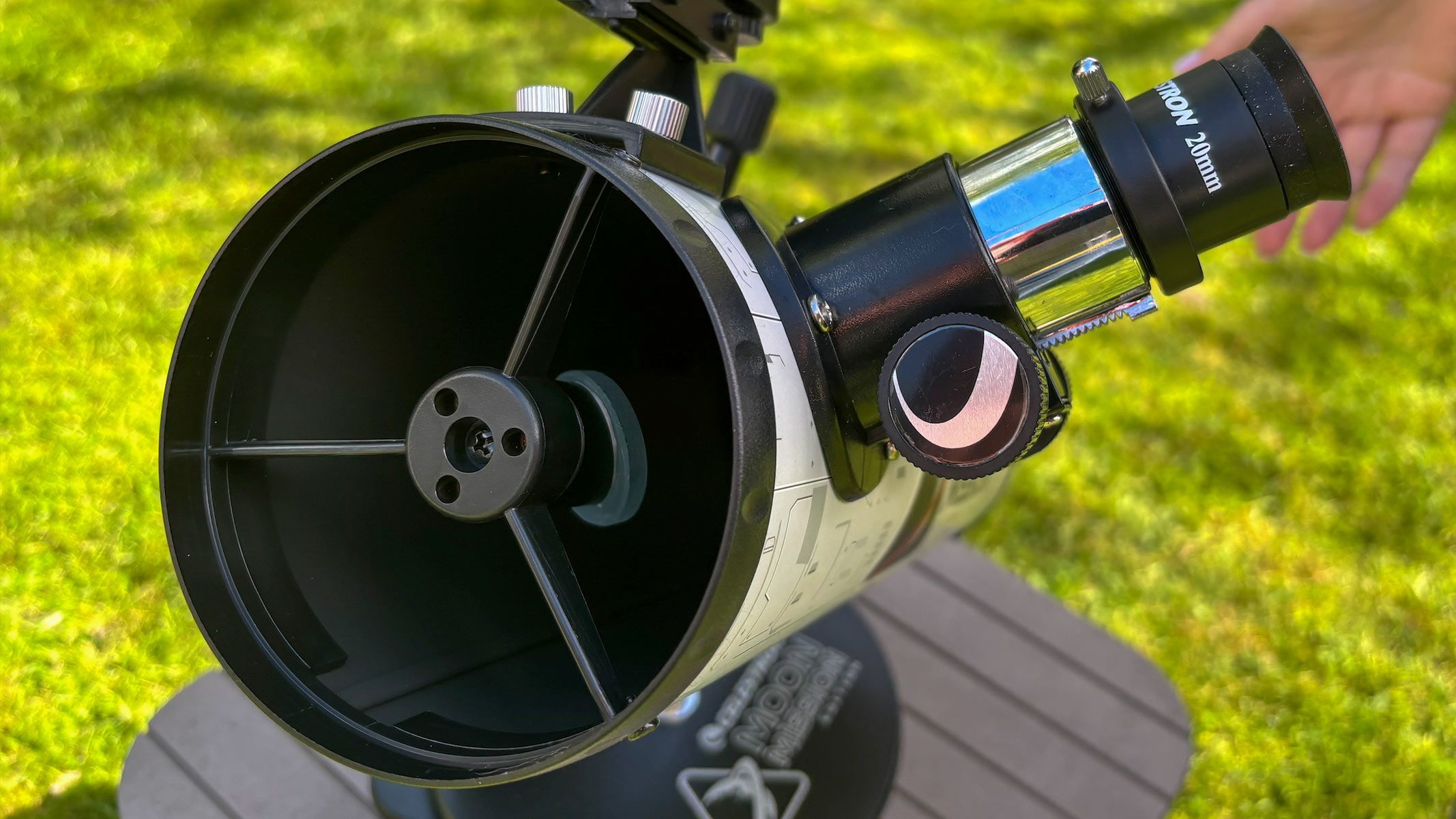
The Celestron Moon Mission 100mm Tabletop Dobsonian comes out of its box complete, other than its eyepieces and red-dot finderscope in plastic bags. Set-up takes literally minutes — remove the plastic cap over the aperture and the cap on the focuser, insert your eyepiece of choice, screw on the finderscope and you are ready to go. No tools such as screwdrivers or Allen keys are needed— it is just a matter of unscrewing thumbscrews.
We found the finderscope went on easily — more about that later. However, the tiny thumbscrews that lock in the eyepiece were incredibly tight. Pliers didn’t help much and risked damaging the screw. In the end, we found elbow grease was just about enough to unscrew them, but if our review model is typical, then children will definitely need the help of an adult to unscrew these. Once they are unscrewed, they can be tightened to more forgiving tolerances.
Optical design:Newtonian reflector
Aperture: 3.9 in (100 mm)
Focal length:15.75 in (400 mm)
Focal ratio: f/4
Eyepiece focal lengths & magnification: 20mm (20x) and 8mm (50x)
Weight: 2.4 lbs (1.08 kg)
Mount type: Dobsonian
Overall we can recommend the build quality of the Celestron Moon Mission 100mm Tabletop Dobsonian. Everything is sturdily made, from the Dobsonian base, the optical tube, the easily adjustable tilt and focuser knobs. The mount has a single arm and rotates on a ‘lazy Susan’ turntable.
Celestron Moon Mission 100mm Tabletop Dobsonian: Performance
- Three
- Bullet
- Points
This is where we thought that the Celestron Moon Mission 100mm Tabletop Dobsonian excelled. For such a small telescope, it was decently versatile.
For example, on the night of April 5, our first target was Jupiter, which was bright in Gemini, and unmistakable as it lay not far from the constellation’s twin stars Castor and Pollux. Jupiter appeared as a bright disk, with perhaps the merest hint of its banding — or was that our imagination? What certainly were real were the four Galilean moons: Io and Europa on one side, Ganymede and Callisto on the other. It was a sight sure to impress beginners and casual observers.
We moved the Celestron Moon Mission’s view towards the multiple star Castor, and the telescope capably split the main binary pair as two close, white stars using the 20mm eyepiece. Another popular multiple star is Mizar and Alcor in Ursa Major. Of course, Mizar and Alcor can be split with the naked eye, but the third visible star in the system is for telescopes only, and again the Celestron Moon Mission showed the three stars clearly.
Slewing east, Arcturus — the second brightest star visible from the U.K., and fourth brightest in the entire sky — appeared a glorious red, evoking its nature as a red giant.
While waiting for the moon to rise (and before taking some time out to watch the Artemis II coverage), we decided to track down some faint fuzzies. The box that the Celestron Moon Mission comes in highlights the Orion Nebula and the Andromeda Galaxy as two deep sky objects that the telescope can see. At the time of testing, the Orion Nebula was too low in the west, while the Andromeda Galaxy was not visible. Instead, we hunted down two other nearby galaxies, M81 and M82, in Ursa Major.
Searching for these two galaxies, which are located next to each other in the same field of view, is where the real challenge of using the finderscope, as we described in the Functionality section, really reared its head. In the end, we decided to star hop to the galaxies and struck out in roughly the right direction. Soon the telescope alighted on the two galaxies, visible as two fuzzy patches of light. Looking at them straight on, we found it difficult to discern their shape, but by using averted vision as we looked through the 20mm eyepiece of the Celestron Moon Mission, we could make out the broad disk-shape of the spiral M81, and the elongated cigar shape of M82, and even caught hints of mottling with brighter spots in the edge-on M82 that are better seen in images.
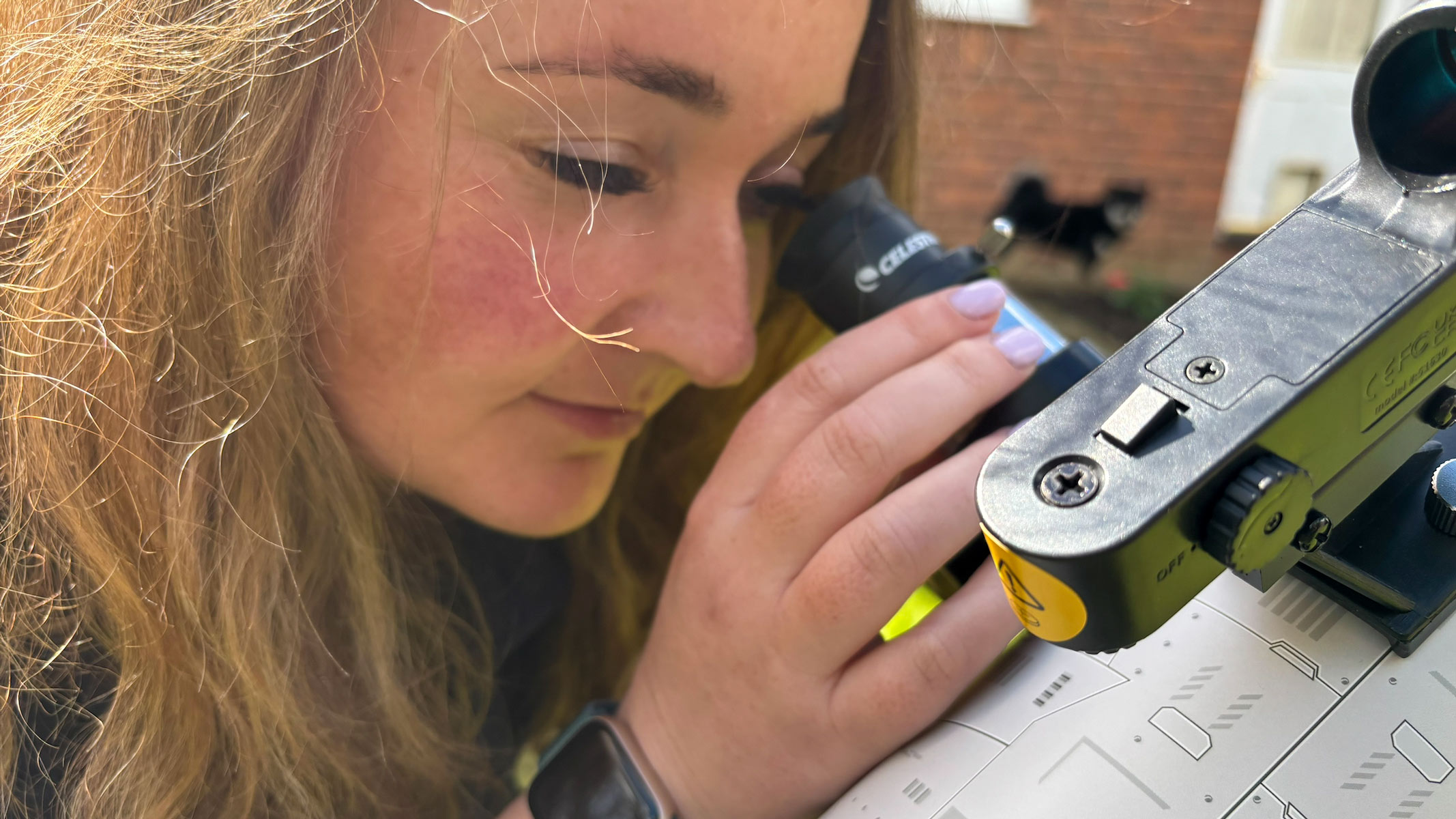
After we watched the live NASA feed of Artemis II going around the far side of the moon, the moon finally rose from our location after midnight. Its phase was a waning gibbous three days after full. As such, the moon appeared bright and reddish, being low to the horizon. Through the 20mm we could see the whole disk, though the phase meant that for most of the lunar surface there was no contrast, making it harder to distinguish craters except for at the terminator.
Adding the 1.25-inch moon filter — more properly known as a neutral density filter that dims the incoming light — helped to limit the contrast and make the details stand out more. Switching to the 8mm eyepiece, with a magnification of 50x, the view jumped closer to the moon and the lunar surface filled the field of view, with bright crater rays visible on dark lunar mares.
Celestron Moon Mission 100mm Tabletop Dobsonian: Functionality
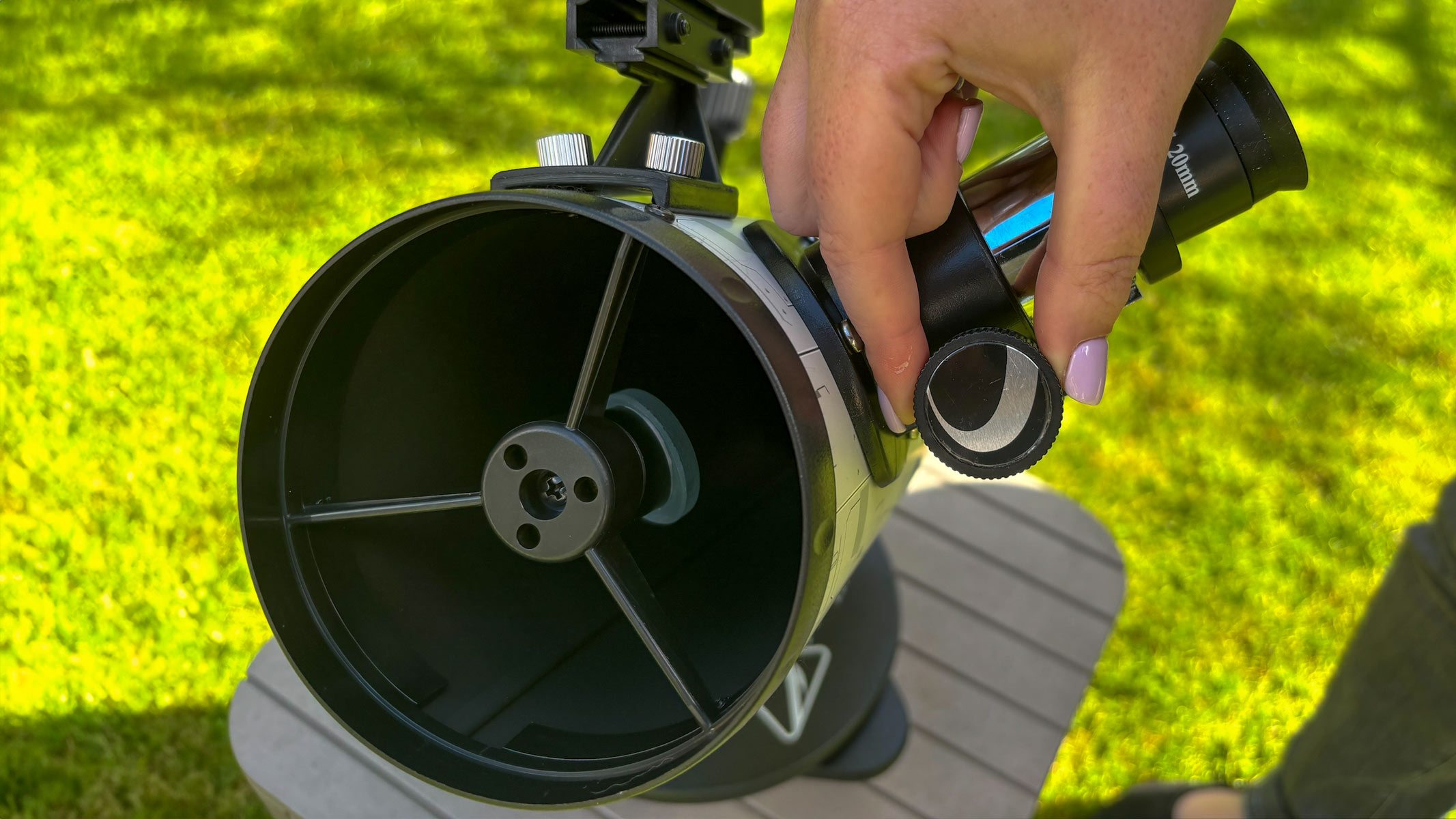
- Finderscope is awkward to use when pointed at the zenith
- Focusing is adequate
- Simple to use
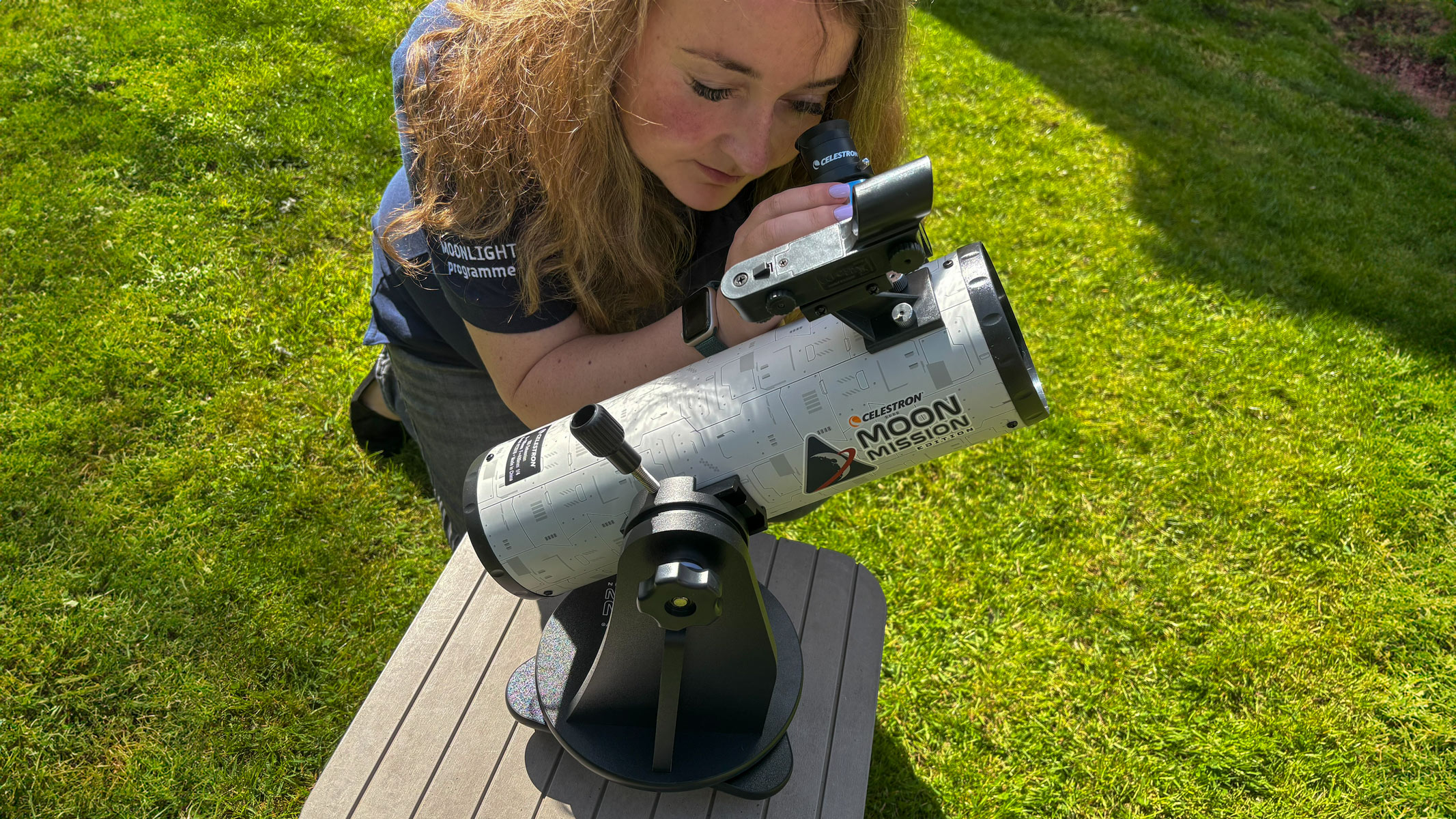
The tabletop nature of the telescope poses some challenges for adults using it. As its name suggests, the telescope is designed to go on the top of a table. Usually when we think of Dobsonian telescopes, we think of very large instruments with very large apertures, and eyepieces close to standing height. This Dobsonian, on the other hand, is very small, and without a very tall table we found that we spent a lot of our time bent double looking through the eyepiece. Of course, this also means it is the perfect height for a child.
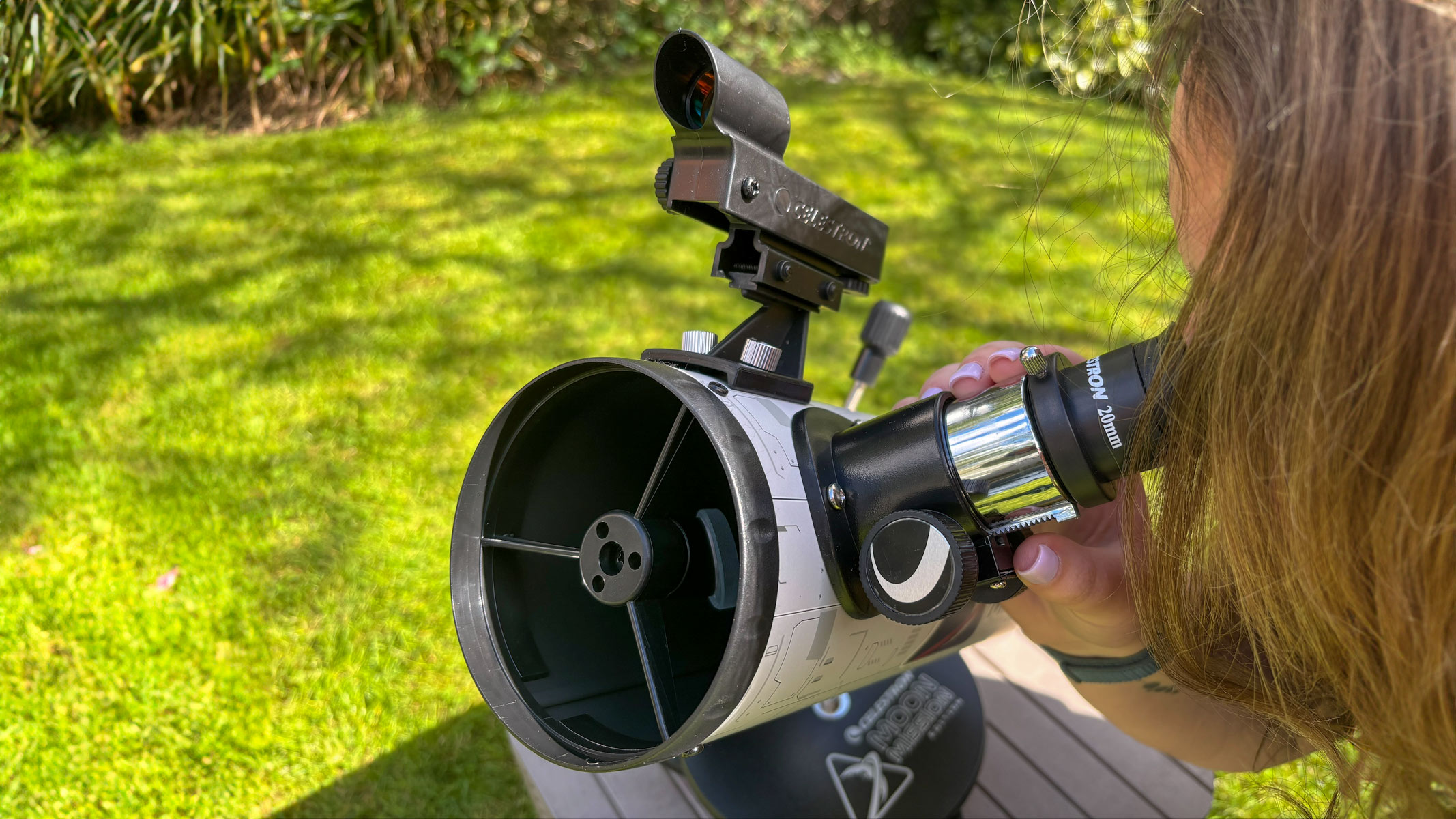
We found it did pose a problem when using the finderscope. For objects at low elevations, such as Jupiter in Gemini during spring 2026, we found it wasn’t too bad. However, when we wanted to direct the telescope towards Ursa Major at the zenith, the only way we could look through the finderscope was by literally getting on the floor to look through it. This is a problem with all tabletop telescopes, not just the Celestron Moon Mission, and it would be unfair to suggest otherwise — but it is a problem nonetheless.
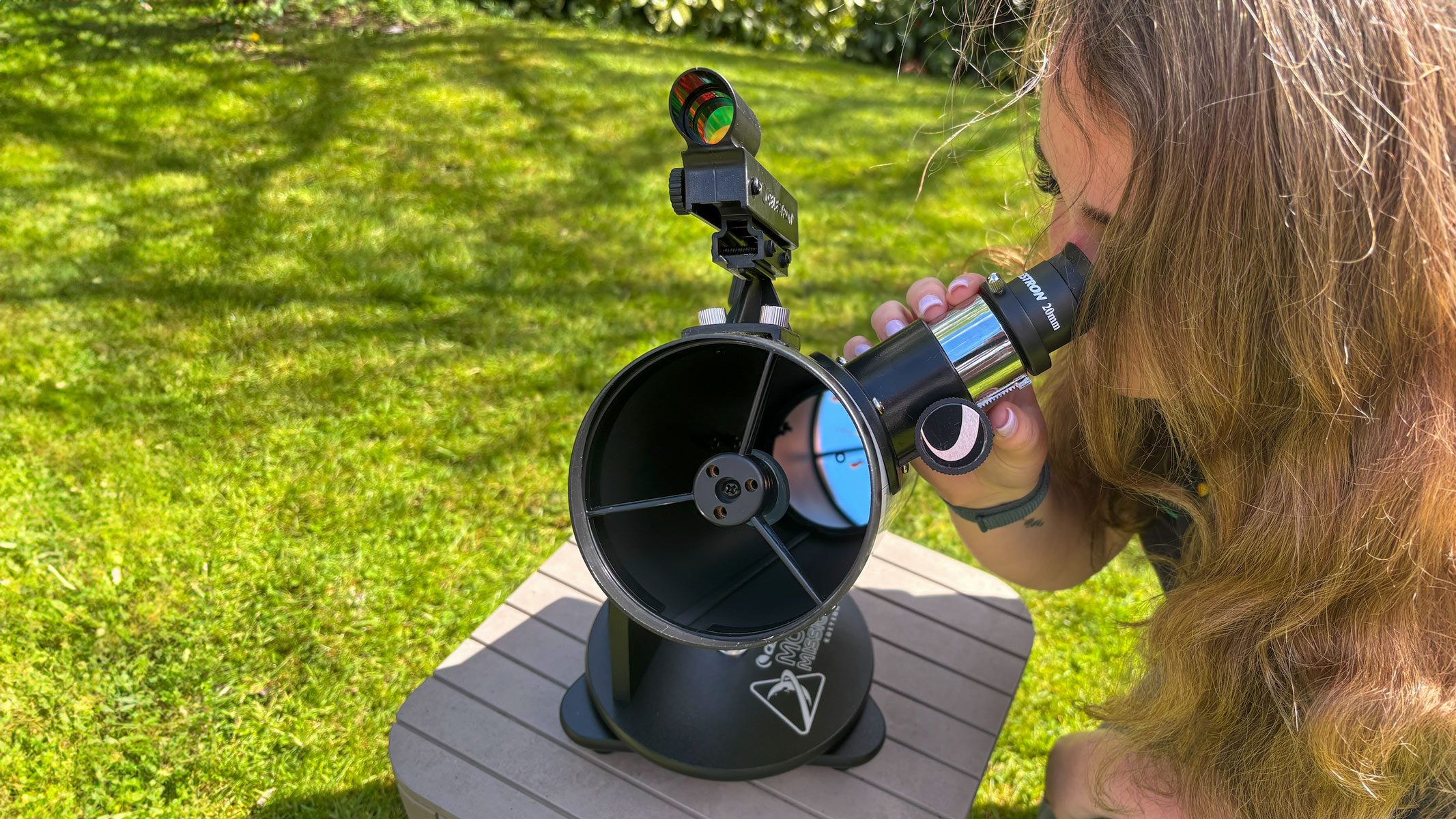
Once we addressed the tightness of the focuser thumbscrews, we could switch the eyepieces in and out with ease. We found the focuser to be perfunctory. It provides only coarse focusing, with no careful fine-tuning, and sometimes it was tricky to find the sweet spot. Additionally, Newtonian reflectors like this one require collimating for perfect pin-sharp images. Collimating refers to adjusting the secondary mirror (the primary mirror is fixed at the base of the optical tube) so that it aligns and focuses light reflected from the primary just so. It’s also a fact that astronomers hate collimating, as it is a finicky procedure.
Out of the box, the collimation wasn’t bad, and we felt it was also unreasonable to expect beginners and children, whom this telescope is undoubtedly aimed at, to collimate the instrument with no guidance or tools included. Therefore, we reviewed the telescope as it came out of the box, to replicate the experience that beginners and children would receive. Had we collimated the telescope, then it probably would have improved the image a tad.
We found that actually using the telescope, in terms of positioning and pointing, was very simple. It’s worth remembering that Newtonian reflectors reverse their image (up becomes down), and after using smart telescopes, GoTo telescopes and Celestron’s StarSense telescopes with directions provided by a smartphone for so long, that took a little getting used to again! It may confuse beginners and children, but before the days of smart telescopes and GoTo, everybody had to get used to navigating across the sky using a reversed image, so it’s no bad thing.
Should you buy the Celestron Moon Mission 100mm Tabletop Dobsonian
✅ You are a beginner
✅ You are a parent wanting to introduce your child to the night sky
✅ You are looking for ease of use
✅ You are working on a budget
✅ You need portability
❌ You are a serious observer and need larger apertures
❌ You are an astrophotographer and need a driven mount
❌ You want a high-tech instrument with smart capabilities
❌ You don’t want to have to star-hop and would prefer a GoTo
If you want to introduce your children to astronomy, then the Celestron Moon Mission 100mm Tabletop Dobsonian is the perfect instrument. It is safe to use, with no risk of knocking something heavy over, as it weighs about the same as a bag of sugar, which is amazing really. It is simple to use, in the sense that it is just a matter of pushing and turning, although children might need assistance in pinpointing the location of targets. It’s also a fair all-rounder, as all Dobsonians are – it excels at showing the moon, displays the planets very well, and shows deep-sky objects as best it can for a 100mm-aperture telescope
If you want to see fainter galaxies and nebulae, then you will need a telescope with a larger aperture. If you want to do imaging, then you will need a telescope with a motorized equatorial drive to enable you to track the objects while imaging.
And if you want assistance in finding celestial objects without having to star-hop, then a GoTo or smart telescope might be best for you.
If the Celestron Moon Mission 100mm Tabletop Dobsonian isn’t for you
If you’re looking to spend less, Celestron offers a smaller Dobsonian, the Celestron Firstscope 76. For a more flexible telescope, take a look at the Celestron Inspire 100Z. Or if neither fits the bill, we’ve rounded up the best telescopes and best beginner’s telescopes.
How we tested the Celestron Moon Mission 100mm Tabletop Dobsonian
We used the Celestron Moon Mission 100mm Tabletop Dobsonian during the occasional clear nights in the first two weeks of April 2026 from our south-facing garden in the United Kingdom. The temperature was clement, about 50 degrees Fahrenheit (10 degrees Celsius), with some modest light pollution to the north and dark skies to the south looking towards a more rural area.
We began observing after 10 pm, with the skies completely dark. The moon was near full at the time of testing — in fact, quite fittingly, one of the nights was the same night that the Artemis II mission went around the moon. However, the moon remained low the entire night, meaning it could only be viewed near moonrise after midnight, close to the horizon, before it became hidden behind a nearby bank of trees for the rest of the night.
Want help choosing the right stargazing equipment? We have guides to the:
Best telescopes
Best telescopes for kids
Best telescopes for beginners
Best smart telescopes
Best telescopes for deep space